

The NSX Concept seen here and in the final scene of 'The Avengers' has an interesting backstory to it. (David Undercoffler / Los Angeles
|

Wednesday, June 13, 2012
American Honda Reports May Auto Sales: Civic, CR-V and Accord Fuel Honda Double-Digit Sales Gain; New Acura RDX Sets All-Time Monthly Sales Record
Honda division sales up 46 percent, Acura sales up 62 percent
EDITOR'S NOTE: American Honda has made several changes to the format of its monthly sales press release. The sole release now contains insights and quotes for both the Honda and Acura brands, and in response to continued requests from the media, now highlights unadjusted sales figures in order to be consistent with the prevailing industry practice. Overall sales are still initially noted in the release according to the daily selling rate (DSR), and the accompanying sales figures chart now presents columns for both adjusted DSR sales figures and unadjusted sales figures. This will be Honda's reporting practice going forward.
American Honda today reported May 2012 U.S. sales of 133,997 units, an increase of 47.6 percent compared to May 2011 (an increase of 36.3 percent based on the daily selling rate*). The Honda Division posted May 2012 sales of 119,411 units, an increase of 46.0 percent compared to May 2011. Acura 's U.S. May sales of 14,586 units increased 62.1 percent compared to May 2011.
Honda
- Civic sales up more than 80 percent compared to May 2011; an exceptional sales figure for any month, Honda sold 33,490 Civics in May
- CR-V sets a May sales record (25,186 units), besting previous record by 5,226 units, leading Honda to a May record for light truck sales
- Accord sales (29,737 units) continue to show strength in the tough mid-size segment, up more than 70 percent from May 2011
"With our best May sales performance since before the financial crisis it 's obvious Honda 's return to strength is in full swing,, and our May sales are impressive irrespective of last year 's production supply problems," said John Mendel, American Honda executive vice president of sales. "Any time Honda Civic sales surpass 33,000 units in a month, it shows real demand in the marketplace."
Acura
- Total Acura sales of 14,586 units were up 62.1 percent, making this Acura 's best month since December of 2010
- The RDX had its best sales month ever (3,301 units), with May 2012 sales up 216.8 percent. The RDX is expected to be at the top of the compact luxury SUV segment
- Overall, Acura light trucks posted a best-ever May result of 8,226 units, up 64.7 percent
- The all-new ILX compact luxury sedan went on sale May 22. As dealer inventory builds, the ILX marketing campaign launches with national TV advertising beginning in early June with the NBA conference finals on ESPN
"With the new RDX setting an all-time sales record this month, Acura went well beyond recovering from last year 's supply issues," said Jeff Conrad, vice president of Acura sales.
"Now, with the new ILX reaching dealerships across America, Acura is just beginning a great new hot streak."
*The daily selling rate (DSR) is calculated with 26 days for May 2012 and 24 days for May 2011. Year-to-date, the DSR is calculated with 127 days for 2012 and 126 days for 2011. All other percentages in release are unadjusted; see table for adjusted DSR figures.
For more information about Honda vehicles, please visit www.automobiles.honda.com. For media inquiries please visit www.hondanews.com. For more information about Acura vehicles, please visit www.acura.com. For media inquiries please visit www.acuranews.com.
Thursday, May 31, 2012
Honda cranks up the heat at Indy
By John Oreovicz | ESPN.com
http://espn.go.com/video/clip?id=espn:7977799
INDIANAPOLIS -- Honda knows what it's like to be humbled at the Indianapolis Motor Speedway.
One of the world's most respected carmakers struggled mightily in its first attempt at the Indianapolis 500 back in 1994. When its overweight and underpowered engines put Bobby Rahal and his team in jeopardy of failing to qualify, Rahal abandoned his Hondas and leased a pair of Ilmor-powered cars.
Honda also knows how to rebound quickly. Just a year after the embarrassing 1994 DNQ, Scott Goodyear looked like he had victory in the '95 Indy 500 in the bag until he inadvertently passed the pace car on a late restart. The CART/IRL war meant Honda didn't get another shot at Indianapolis until 2003, but it won every 500 since 2004, the past six as the exclusive engine supplier to the IZOD IndyCar Series.
Engine manufacturer competition returned to the IndyCar Series in 2012, and up through last Friday, Honda found itself getting humbled again. Chevrolet and Penske Racing won the first four races of the season on road and street courses, then swept nine of the top 10 grid positions at Indy.
But suddenly on Carb Day, the tide turned in Honda's favor. Dario Franchitti and Scott Dixon ran 1-2 for Target Ganassi Racing, and they repeated that result in the race, with Franchitti literally brushing off a last-lap challenge from Takuma Sato to record his third Indianapolis 500 victory.
On race day, the Hondas not only outpaced the Chevrolets, they also consistently ran a lap or two longer on a tank of Sunoco race fuel.
What on earth happened? After pretty much getting its doors blown off in the first four races of the season, plus in Indianapolis qualifying, could Honda have suddenly regrouped and produced the dominant engine for race day?
Yes, it did.
"Honda made a massive, massive improvement after qualifying," said Franchitti, who has utilized Honda power for every one of his 31 Indy car race wins. "I really take my hat off to those guys because we really gave them a hard time after qualifying. I mean, you know how upset I was on qualifying day. I was angry. I had no expectations coming in, but I thought we'd be quick, and we weren't. I think I was fairly honest and clear about being upset with it.
"The Honda guys have worked hard since before the start of the season, but they've been playing catch-up," he continued. "When they made the turnaround from Sunday to Carb Day, it was very impressive. They continue to amaze me."
There were a lot of furrowed brows in the Honda camp after qualifying at Indianapolis. The Honda cars were consistently 2-3 mph slower than the fastest Chevrolet-powered entries from the Penske and Andretti Autosport teams.
But Honda Performance Development assured its teams it had an upgrade coming. They just had to wait until their existing engines reached the end of their 1,850-mile life as required by INDYCAR regulations.
"That was our first chance to show the next step in our evolution," explained HPD assistant vice president Steve Erickson. "I think Chevrolet had an early benefit, particularly when they switched to fresh engines at Long Beach. That was an upgrade that didn't match the league's planning, so of course there was a penalty. But they were on the next iteration of engine from Long Beach on, whereas we were following the regulations that said when you get to the end of your 1,850 miles of engine life, then you put in your next iteration. That's what we did here."
While the Ganassi cars suddenly gained pace on Carb Day with the Step 2 Honda motors, it wasn't until a couple of long green-flag stints in the race that it became obvious the upgraded Honda also was making better fuel mileage than the Chevys.
"Everybody wants more power and better fuel economy, and oftentimes those are opposed," Erickson said. "In this particular case, the improvements that we made actually achieved both. When you have that, it's a really special situation."
Still, Chevrolet was in a position to win the race right up to the very end. KV Racing Technology's Tony Kanaan led into the final restart, but his third-place finish ended up leading a 3-4-5-6 string for the Bowtie brigade.
Chevrolet's advantage was magnified in qualifying, because Honda did minimal development tuning its first-generation engine for the increased turbocharger boost that was implemented at the last minute.
Knowing it would introduce its upgrade after qualifying, Honda bit the bullet and basically got embarrassed in qualifying. Josef Newgarden of Sarah Fisher Hartman Racing was the marque's top qualifier in seventh place, and Ganassi's Dixon and Franchitti lined up 15th and 16th.
But Franchitti showed his hand early in the race when a pit lane spin caused by E.J. Viso knocked him to the back of the pack. The Scotsman calmly drove through the field and put himself back in contention without the benefit of a full-course caution or alternate pit strategy.
His effort resulted in a dream result for Honda and HPD, the company's racing engine division based in Santa Clarita, Calif.
HPD started out in the early '90s as a rebuild facility while design, development and manufacture of its Indy car engine took place in Japan. But it took on additional responsibilities over the years to the point where the Honda engine is now the only engine in Indy car competition that is designed and manufactured in America.
"The Indy 500 has been our No. 1 company goal -- above all, make no mistake, the Indy 500 is it," HPD's Erickson said. "Everything else falls below that. So everything about our development program was focused on winning the Indy 500. A lot of overtime, a lot of long nights went into achieving this one goal.
"We worked long and hard to bring engine manufacturer competition back to the IndyCar Series because it means so much to us and our associates," he added. "This is why we race, and winning today is payback for all the hard work we put in to get to this point."
http://espn.go.com/video/clip?id=espn:7977799
INDIANAPOLIS -- Honda knows what it's like to be humbled at the Indianapolis Motor Speedway.
One of the world's most respected carmakers struggled mightily in its first attempt at the Indianapolis 500 back in 1994. When its overweight and underpowered engines put Bobby Rahal and his team in jeopardy of failing to qualify, Rahal abandoned his Hondas and leased a pair of Ilmor-powered cars.
Honda also knows how to rebound quickly. Just a year after the embarrassing 1994 DNQ, Scott Goodyear looked like he had victory in the '95 Indy 500 in the bag until he inadvertently passed the pace car on a late restart. The CART/IRL war meant Honda didn't get another shot at Indianapolis until 2003, but it won every 500 since 2004, the past six as the exclusive engine supplier to the IZOD IndyCar Series.
Engine manufacturer competition returned to the IndyCar Series in 2012, and up through last Friday, Honda found itself getting humbled again. Chevrolet and Penske Racing won the first four races of the season on road and street courses, then swept nine of the top 10 grid positions at Indy.
[+] Enlarge
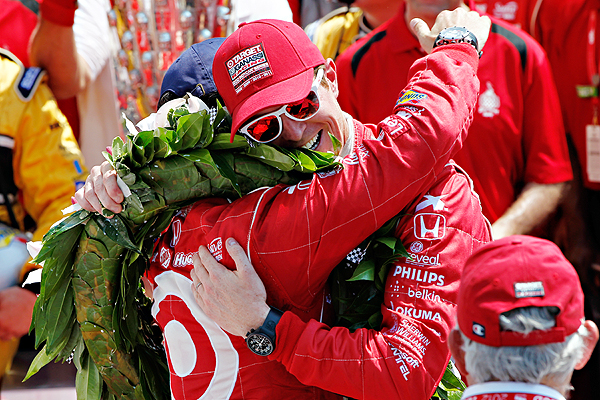
Jonathan Ferrey/Getty ImagesDario Franchitti, left, and Scott Dixon qualified 16th and 15th for the Indy 500 in Honda-powered machines, but they finished 1-2 on race day.
But suddenly on Carb Day, the tide turned in Honda's favor. Dario Franchitti and Scott Dixon ran 1-2 for Target Ganassi Racing, and they repeated that result in the race, with Franchitti literally brushing off a last-lap challenge from Takuma Sato to record his third Indianapolis 500 victory.
On race day, the Hondas not only outpaced the Chevrolets, they also consistently ran a lap or two longer on a tank of Sunoco race fuel.
What on earth happened? After pretty much getting its doors blown off in the first four races of the season, plus in Indianapolis qualifying, could Honda have suddenly regrouped and produced the dominant engine for race day?
Yes, it did.
"Honda made a massive, massive improvement after qualifying," said Franchitti, who has utilized Honda power for every one of his 31 Indy car race wins. "I really take my hat off to those guys because we really gave them a hard time after qualifying. I mean, you know how upset I was on qualifying day. I was angry. I had no expectations coming in, but I thought we'd be quick, and we weren't. I think I was fairly honest and clear about being upset with it.
"The Honda guys have worked hard since before the start of the season, but they've been playing catch-up," he continued. "When they made the turnaround from Sunday to Carb Day, it was very impressive. They continue to amaze me."
There were a lot of furrowed brows in the Honda camp after qualifying at Indianapolis. The Honda cars were consistently 2-3 mph slower than the fastest Chevrolet-powered entries from the Penske and Andretti Autosport teams.
But Honda Performance Development assured its teams it had an upgrade coming. They just had to wait until their existing engines reached the end of their 1,850-mile life as required by INDYCAR regulations.
"That was our first chance to show the next step in our evolution," explained HPD assistant vice president Steve Erickson. "I think Chevrolet had an early benefit, particularly when they switched to fresh engines at Long Beach. That was an upgrade that didn't match the league's planning, so of course there was a penalty. But they were on the next iteration of engine from Long Beach on, whereas we were following the regulations that said when you get to the end of your 1,850 miles of engine life, then you put in your next iteration. That's what we did here."
While the Ganassi cars suddenly gained pace on Carb Day with the Step 2 Honda motors, it wasn't until a couple of long green-flag stints in the race that it became obvious the upgraded Honda also was making better fuel mileage than the Chevys.
"Everybody wants more power and better fuel economy, and oftentimes those are opposed," Erickson said. "In this particular case, the improvements that we made actually achieved both. When you have that, it's a really special situation."
Still, Chevrolet was in a position to win the race right up to the very end. KV Racing Technology's Tony Kanaan led into the final restart, but his third-place finish ended up leading a 3-4-5-6 string for the Bowtie brigade.
Chevrolet's advantage was magnified in qualifying, because Honda did minimal development tuning its first-generation engine for the increased turbocharger boost that was implemented at the last minute.
Knowing it would introduce its upgrade after qualifying, Honda bit the bullet and basically got embarrassed in qualifying. Josef Newgarden of Sarah Fisher Hartman Racing was the marque's top qualifier in seventh place, and Ganassi's Dixon and Franchitti lined up 15th and 16th.
But Franchitti showed his hand early in the race when a pit lane spin caused by E.J. Viso knocked him to the back of the pack. The Scotsman calmly drove through the field and put himself back in contention without the benefit of a full-course caution or alternate pit strategy.
His effort resulted in a dream result for Honda and HPD, the company's racing engine division based in Santa Clarita, Calif.
HPD started out in the early '90s as a rebuild facility while design, development and manufacture of its Indy car engine took place in Japan. But it took on additional responsibilities over the years to the point where the Honda engine is now the only engine in Indy car competition that is designed and manufactured in America.
"The Indy 500 has been our No. 1 company goal -- above all, make no mistake, the Indy 500 is it," HPD's Erickson said. "Everything else falls below that. So everything about our development program was focused on winning the Indy 500. A lot of overtime, a lot of long nights went into achieving this one goal.
"We worked long and hard to bring engine manufacturer competition back to the IndyCar Series because it means so much to us and our associates," he added. "This is why we race, and winning today is payback for all the hard work we put in to get to this point."
Monday, May 14, 2012
Saturday Drive: The story behind 'The Avengers' Acura NSX
 |
'The Avengers' Acura NSX
If you were one of the eighteen billion people who went to see 'The Avengers' recently, you probably noticed the film concludes with Robert Downey Jr.'s Tony Stark getting into a dark red Acura convertible and driving off with Bruce Banner.
|
Start off your weekend of motoring with a quick take on something fast, fun or rare that's recently grabbed our attention in the automotive world.
If you were one of the 18 billion people who went to see "The Avengers"recently, you probably noticed the film concludes with Robert Downey Jr.'s Tony Stark getting into a dark red Acura convertible and driving off with Bruce Banner. (Calm down, that's no spoiler).
But unlike the other Acuras making cameos throughout the film (the automaker having stolen the product placement mantle from Audi, whose R8 supercar was Stark's ride in the two Iron Man films), this model doesn't currently exist.
Yet.
Photos: 'The Avengers' Acura NSX
It's a concept of the forthcoming Acura NSX, due out as a coupe around 2015, about the time the just-announced sequel to "The Avengers" will hit theaters. You may also recognize the coupe from the funny, yet controversial Super Bowl commercial featuring Jerry Seinfeld and Jay Leno.
Details on the powertrain of the NSX haven't been released, though Acura has said it will have a mid-mounted V-6 VTEC engine with direct-injection and a dual-clutch transmission routing power to the rear wheels while a pair of electric motors power the front wheels.
Sadly, the car you see here has none of that. But unlike other concept mockups that are as functional as a foam chainsaw, this one is a working, drivable model. And the car it's based on may surprise you.
"It's bitchin'," says Dave Marek as he looks at the concept.
We're in a vacant parking lot in Torrance on the sprawling campus of the North American headquarters for Honda, Acura's parent company. Steps away is one of the company's key R&D centers, a fortress holding the future products for both brands that not even Iron Man could break into.
A bit of an institution at Honda, Marek has been designing Hondas and Acuras for well over two decades. His work includes the original Honda Accord station wagon, the Honda Ridgeline and Acura MDX. He's now the director of design at the company and was integral in bringing the NSX concept to life for its silver screen debut.
Marek says the project began in June 2011, when he was handed the final pages of "The Avengers" script and told that a car was needed for Stark's parting shot. Initially the plan was to mock up just the rear of the car, since that's all that was needed for filming. But at the request of none other than the film's director and screenwriter Joss Whedon, it was decided to use a full car.
This meant that Marek and his team had three months to create a working, film-ready car in time for the scene to be filmed in New York City's Central Park during Labor Day weekend in 2011.
Deciding exactly what this film car would look like proved to be a bit of a challenge.
As you may know, Acura didn't officially unveil the NSX concept or even confirm the company planned to bring the car to market until the Detroit Auto Show in January 2012. Yet Acura knew that photos of the film car would hit the Internet immediately after filming its scene in September 2011, four months before the Detroit show. This was because New York City doesn't allow film crews to block public access while filming in Central Park.
(And hit the Internet they did, sparking breathless speculation as to whether the concept seen filming indicated a revival of the NSX nameplate.)
In anticipation of this, Marek and his team took the already-finalized design for the official NSX Concept and tweaked it a bit to throw off people who were on the scent for NSX clues.
The biggest difference is the film car is a convertible while the official NSX Concept is a coupe. The front end of the film car was also deliberately left vague (there are no headlights, functional or otherwise) and the sculpting of the hood and front bumpers is relatively straightforward when compared to the concept shown in Detroit.
Once the design for the film car was finalized, Marek's team had Oxnard-based Trans FX build it. While the name might not sound familiar, TFX are the minds behind such film vehicles as the Fantasticar in the 2007 "Fantastic Four," an alien spacecraft in "Men in Black II," and life-size replicas of the cars from Disney's "Cars 2."
But rather than build "The Avengers" car from the ground up, Marek's team and the crew at TFX drew on the history of the Acura NSX as inspiration.
Is a Buick coming back? GM trademarks Riviera name
By Chris Woodyard, USA TODAY

Is Buick bringing back the Riviera?
The answer is a definitive maybe. It has filed a trademark for the famous name of big, sporty vehicles, GM Inside News reports. But even though it produced a Riviera concept four years ago, it may be that GM is just trying to protect the name for use on a future product, but not one anytime soon.

General Motors
The Buick brand has been gaining momentum in recent years with popular entries such as the Enclave and the LaCrosse. As the premium marque continues to fill out its lineup with compact entries like the Encore and the Verano, it might even be able to use a new Riviera to plug a hole in the lineup.
From the 1963-99 model years, the Riviera was a halo coupe car for Buick. Trademarking the Riviera name doesn't necessarily mean GM plans on making a production vehicle or even a concept vehicle for that matter. However, there are some indications that it wants to further expand the Buick lineup — especially to capitalize on growing sales in China, where Buick is one of the largest brands.
Two years ago, Buick told Cars.com that it was considering adding a coupe, convertible and wagon to its lineup.
If those models are still in the cards, it's possible that the coupe/convertible could get the Riviera nod, but we'll just have to wait and see.
Mark Phelan: Racing to build up Buick brand: Engineers to run street-legal Regal GS in Nevada contest

From left, navigator John Townsend and driver Bill Rietow with the Buick Regal GS that finished first in the 120-m.p.h. class of last fall's Silver State Classic challenge. / General Motors photos
Catch the Buick Regal GS -- if you can. This time next week, a pair of GM engineers will be piloting one of the turbocharged sport sedans down a Nevada highway at speeds that could top 150 m.p.h. as the brand burnishes its performance credentials.
Buick was a big deal in motor sports for decades. Success in early 20th-Century cross-country rallies gave it a sterling reputation for durability and performance. Decades later, powerful and advanced engines powered Buick to success in NASCAR and at the Indy 500. The brand grew stodgy since the '80s, but cars like the turbocharged GNX were fast and furious road-racing bad boys before anybody ever heard of Vin Diesel.
Engineers Bill Rietow, 60, and John Townsend, 56, hope to revive some of that excitement running a street-legal Regal GS in the Silver State Classic challenge on Nevada's famous State Route 318 next Sunday.
"Consumers recognize that motor sports are a breeding ground for new technologies," said Silvia Mammone, who's involved in a range of racing as Michelin and BF Goodrich tires' North American motor sports manager. "It's a great way to speak to customers who are interested in technology and performance."
The Silver State Classic is a time and distance race. Drivers and navigators compete to see how close they can come to exactly hitting their target speed. The 90-mile course includes curves, hills, dips and "the narrows," a tricky canyon. They'll hit 90 m.p.h. in the narrows, and do well over 135 m.p.h. on other stretches. State Route 318 is closed to the public during the challenge, which draws hundreds of competitors.
The demanding course requires racing skill, plus the ability to calculate speed and distance on the fly. This'll make you weep if you struggle to balance your checkbook: In their rookie race last fall, engineers Rietow and Townsend used a handheld stopwatch, GPS and the car's standard cruise control for a first-place average of 119.9991 m.p.h.
"I love to compete," Rietow, who was GS lead development engineer, said. "This race is an engineering challenge and a (math) problem you have to solve at extremely high speeds. It's also an opportunity to let the car stretch its legs."
Rookies can't compete at more than 120 m.p.h. Having passed that test with flying colors, Rietow and Townsend could top the 157 m.p.h. that's the top speed a GS hit on GM's high-speed circuit at its Milford proving grounds.
They plan to enter the 135-m.p.h. class because of forecast 20-m.p.h. headwinds, but they could switch classes if the weather changes.
The car they'll use is identical to the 270-horsepower manual transmission Regal GS in Buick showrooms, except for mandatory safety equipment -- racing seats, five-point belts, a roll hoop, fire extinguisher, helmets, neck-protecting HANS devices and fire suits. GM also had Pirelli X-ray the car's stock P-Zero summer tires, a company rule for high-speed runs. Microscopic irregularities that don't matter in normal driving could be disastrous at 150 m.p.h.
Rietow and Townsend plan to run at 138-140 m.p.h. over the first 61 miles, hitting the max speed at mile marker 47. At 90 m.p.h. in the narrows they'll be taking some curves at 0.7 g or more. Rietow will floor it leaving the canyon. They'll shoot for 135 m.p.h. on the nose over the last 14 miles, fine-tuning as needed with GPS and the handheld stopwatch.
"You have to be quick thinkers -- problem solvers," Rietow said. "I'm smiling just thinking about it."
If the idea that the Regal GS is a curve-hugging 140-m.p.h. sport sedan catches on with enthusiasts, everybody at Buick will be smiling with him.
Contact MARK PHELAN at 313-222-6731 or mmphelan@freepress.com.

Subscribe to:
Posts (Atom)